Monday, 25 August 2014

Deep Breath


I think it was generally accepted before Deep Breath aired that Peter Capaldi was a good casting choice for the Twelfth Doctor. So it shouldn’t really be a surprise that he was the best thing about his debut episode. In an hour and fifteen minutes Capaldi gave a varied performance that was evocative of the character’s history without being entirely beholden to it. There was nothing that sounded like a catchphrase, nothing that looked like a stab at vaudevillian physical comedy. In other words, exactly the sort of performance Matt Smith failed to deliver during his entire tenure.

Perhaps the most pleasing thing about Capaldi was that it was clear how differently he was playing the part to Smith. Having watched Smith’s Eleventh Doctor for the last four years it was all too easy to imagine moments which would have featured an arm flail or a spin or a gurning face. It was intentionally, according to writer Steven Moffat, written as a Matt Smith script for the most part, the Twelfth Doctor apparently still believing himself to be the Eleventh. A move presumably designed to allow the differences between the two actors to be clearly highlighted. Pleasingly Capaldi swallowed the silliness in his lines and instead allowed humour to come from understatement.

But in fairness to Moffat he took some chances with the script. The Doctor was written to do things the Smith incarnation wouldn’t have done, most obviously deserting Clara for a while in the underground lair. It was not the pivotal, shocking moment Moff probably thinks it was, but it did do a nice job of showing that the new Doctor is to be written differently to the last two. That’s a welcome change after eight years.

It’s still too early to judge whether Capaldi’s Doctor will be a success. One episode’s been shown in which, at points, he was written like his predecessor. Nowhere near enough to look at the strengths and weaknesses of Capaldi’s take on the role. Still, he was, as already said, the best thing about the episode.

Not that he had much competition, mind you. The most enjoyable performances after Capaldi came from Dan Starkey’s comedy figure Strax and Michelle Gomez’s Missy. Neither was a large role, with Gomez only appearing in a cameo at the very end of the episode. Nobody else stood out. Jenna Coleman did nothing special, and she was given as much of an opportunity to as she’s ever likely to get, dealing as she was with the loss of what was apparently a great love and having to cope with and rely upon an abrasive stranger. Despite her lines there was never a sense that Clara felt she’d lost a friend. There was never any doubt she’d be fine with this new Doctor at the end of the episode, and not just because we know Clara’s confirmed for the rest of the series.

While Coleman wasn’t especially interesting or good at least she wasn’t actively bad. The same can’t be said for Neve McIntosh’s Madam Vastra. Since she first appeared in 2011’s A Good Man Goes to War Vastra’s speech patterns have gradually become overtly Victorian. “He seems remarkably unmoved by the available spectacle,” for example. This wouldn’t be a problem if it weren’t for the fact that none of the other Victorian characters, most notably Jenny, speak that way. It’s jarring enough to draw my attention whenever she appears. It was particularly bad in this episode because Vastra played a larger role than usual, functioning as the lead character for around the first twenty-five minutes of the episode.

As a season opener Deep Breath just needed to be fun and easy to follow, which it was. As Capaldi’s debut episode it needed to allow him to make a good enough impression to show people he’ll be good in the role, which it did. The plot and the enemies were a recycling of The Girl in the Fireplace, not a problem as that episode first aired eight years ago. That said I did find it peculiar that the lead droid was the only one missing half a face. Why, if his subordinates all got complete faces and bodies, did the lead droid not?

It was a decent offering, although one I doubt people will look back on as a classic. My biggest regret is that the dinosaur didn’t get to become a companion. It displayed a far greater range than Jenna Coleman. If that’s the worst that can be said for it something’s probably gone right.

Friday, 22 August 2014

Far More Than Just Another Human


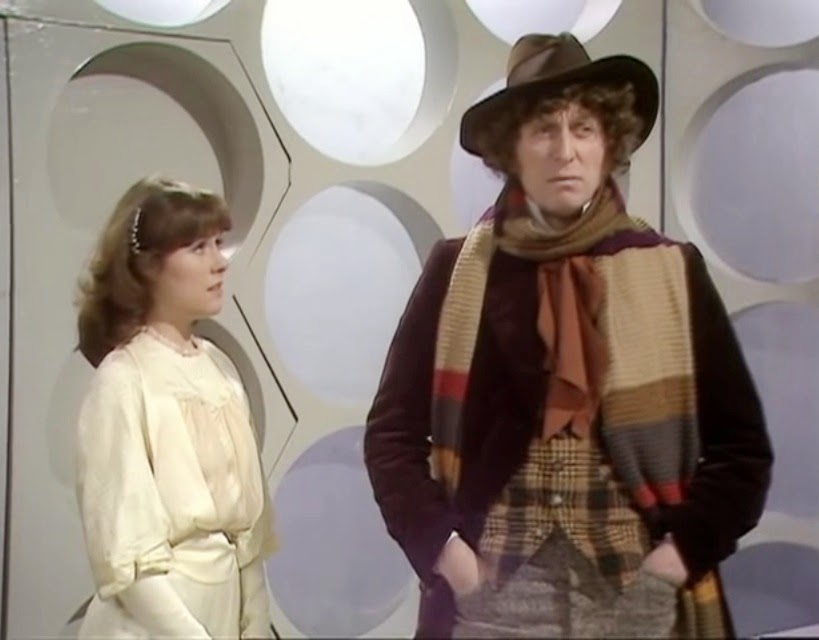
Remember a month or two ago when Moffat said that the Doctor had never, ever categorically stated that he’s not a human? Maybe check out the first few scenes of Pyramids of Mars, where you’ll find Tom Baker’s Doctor categorically stating that he’s not a human.

Good ol’ Moff!

Thursday, 17 July 2014

Silents in The Library?


This is about a story that aired six years ago and a plot arc that was first mentioned four years ago. The link only occurred to me a few months ago. Since then I’ve intended to write something about it but haven’t, mostly because it’s pretty flimsy and uninteresting. But I’m at a loose end so here we are.

Looking back, knowing about the existence of “religious order” The Silence (or, possibly, The Silents) the title of Steven Moffat’s first series four script seems designed to be a “clever” revelation at a later date. It’s safe to assume that he’d had the idea of The Silence for a while, intending to implement them as one of his Big Ideas should he ever get to run Doctor Who. We know that he wrote Silence in the Library and Forest of the Dead after he’d discovered he’d be succeeding Russell the T as the lead exec. Is it possible that Moffat’s intention was to have the Silence appear-but-not-appear in the episodes? A cheeky bit of pre-planning ahead of time as showrunner proper?

Well obviously yes, it is possible. And it would fit with the way in which Moffat’s known to operate. His preferred method for writing Doctor Who (more accurately his preferred method for planning out the big, landmark episodes that are clearly his focus) is to have a vague working idea of where he’s going without too many bothersome specifics worked out. That way he can drop in teasers and tie them together when the appropriate time comes without spending too much time tying himself in knots working all the complexities out. Sometimes it works, as with his tying of the series six opening and closing stories. Sometimes it doesn’t, as it didn’t with River Song, Trenzalore, and the reason for the TARDIS explosion in season five.

It’s also not like Moff is above playing around with titles in this way. He’s admitted that he chose to call the season five finale The Big Bang because he knew it would be the episode in which River Song was conceived in the TARDIS. He’s described that as a dirty joke that only he was in on (giving you a marvellous insight into his maturity and how seriously he takes his job). Silence in the Library would fit snugly into that same approach and, in fairness, be a far more creative example of forward planning and title tomfoolery.

That Moffat has never, to my knowledge, commented on the significance of the Library story’s opening title makes me think that I’m probably reading too much into things. If the Silence were intended to be in the episode, unseen, then he wouldn’t have been able to stop himself from crowing about it after six years. It’s beyond him, not at all within his nature. The man’s too much of a smug show-off. My guess would be that he either got a draft or two in and decided to strip the Silence out and replace them with the less impressive and memorable Vashta Nerada or that RTD had issues with the foreshadowing. It’s known that Moffles had to fight for the inclusion of River Song. Maybe Davies felt that the Silence would be too much left unexplained and gave Moffat the choice of seeding in one or the other. Perhaps he invented The Silence after the Library story was finished and took inspiration for naming them from that episode title.

We’re never going to know. But it’s interesting to think that there could be a connection between the Library two parter and the Moffat era proper beyond an appearance of River Song.

Sunday, 29 June 2014

Take a Deep Breath


“Clara be my pal and tell me, am I a good man?”

“I don’t think I know who the Doctor is anymore.”

That exchange and the publicity shot above them are things the BBC thinks we should be getting excited over. To be honest the teaser trailer featuring the two lines of dialogue did nothing for me. The silhouette of Capaldi looked like it was done through CGI and for some reason that really irritates me. Probably because I’d rather have a shot of Capaldi that’s definitely live action.

Still, the teaser does at least support Moff’s natter about the Doctor being more irascible that he’s been since Eccleston though. Which is a good thing. Or at least it is in theory. How good it is in practice is reliant on Moffat being capable of writing a “snarling beast” leading man with empathy. Going on his career history that’s not something we can rely on.

The picture’s more interesting. Because it shows a new TARDIS set. The purple and gold colouring’s pretty nice. It puts me in mind of the secondary console room, even though it really shouldn’t. Perhaps it’s because the walls look like they’re wooden. Perhaps it actually will prove to be based on the secondary console room when we get to see more of it. It already looks nicer than the last console room. The cold, clinical steel look never did anything for me.

Also pretty old school is the control console being white. Because, y’know, until 2005 we’d only ever had white controls in the TARDIS.

All told it looks like a nice new set. But should that really be the thing that I’m most looking forward to seeing when there’s a new Doctor debuting? The answer, of course, is no.

Oh, and the Twelfth Doctor’s debut episode being called Deep Breath? That’s a bit disappointing, isn’t it?

Saturday, 28 June 2014

Moffat Stays Hyped


You wait for months and months and then a bunch of Doctor Who news comes along at once. Earlier in the week there were a couple of comments from King Showrunner and Keeper of the Canon Lore Steven Moffat that assuaged fears that he might have stopped overhyping things. Then the week ended with the announcement of series eight’s premiere date, a trailer and a publicity still of Clara and the Capaldi Doctor stood in a new TARDIS.

I’ll get to the series eight stuff in another post. For now I want to look at The Moff’s comments.

As far as I’m aware they stemmed from the page Moffat writes for DWM. The first was a mention of series nine. Yes, that’s the series that will air next year, not the one that will air this year that Moffat should be building interest in (because, y’know, it’s his job). He revealed that he’d just written a “whooper” of a cliffhanger for the series’ penultimate episode.

So we know Moff’s writing the episode, which in turn confirms that he’s intending to stay in charge at least until the end of series nine. While it was the done thing for the lead writer to provide the final two episodes of a series under RTD it’s not always been the case under Moffles. Series six featured a penultimate episode from Gareth Roberts (Closing Time, featuring the return of hilarious scamp Craig Owens) and series seven saw Neil Gaiman in the spot (giving us his take Cybermen and space circuses). It’s incredibly unlikely Moff would entrust another writer with the series finale so it’s looking like he’ll be back to writing the final two episodes himself.

Does this mean a proper two part send off to series nine? Well, it’s possible. But… well, it’s not actually been Moffat’s style since taking over. The Chibnall-penned Silurian two parter and the Ganger debacle in the middle of series six aside Moff has tended towards two parters that have a second half that’s distinct in style, tone, story and (often) setting from the first. It was a trend that developed as early as series two as Russell T and the production team realised that the pacing of two part stories for a modern audience just didn’t work without a significant change coming at the halfway point.

The trait has been accentuated under Moff’s reign. It’s one of the things I think he’s gotten right. It’s not only helped to distinguish his era from RTD’s in a positive way (I tend to find most differences negative, as anyone who’s read this blog before will know) but it’s also made for better two part stories than the Davies era could generally muster.

Also worth mentioning is the fact that series seven featured no two part stories at all. Instead Moffat went with his much ballyhooed movie poster approach, which produced such classics as A Town Called Mercy, Hide, and, of course, The Rings of Akhaten. Moffat made a deliberate move away from two parters, saying he felt the show needed a fresh approach. He was probably right, but that he gave us such an average series without them may have caused someone at the BBC to request they be reinstated. Or perhaps The Moff himself has decided they’ve had enough of a rest. Either way it wouldn’t have done his budgets any good: two parters were introduced by RTD specifically as a money saver.

Of course the real thing we should focus on here isn’t two part stories or that Moffat’s sticking around for at least another year. It’s that overhype’s coming into play again. He’s written a whooper of a cliffhanger has he? Great. It’s not like he’s got a history of letting us down on those sorts of promises…

No, hang on a second. He does. The “game changing” revelation that River was Amy and Rory’s kid is my favourite example but there’s also his promise that we’d find out the Doctor’s name in the series seven finale. I enjoyed his promise that Doctor Who would be all over people's screens in 2013. I could point to more but, well, Moffat’s actually provided some fresh material so let’s focus on that.

His other DWM comment saw him say that it’s never been explicitly stated that the Doctor is not human. Having only sat through a small selection of black and white era stories, possessing only a hazy familiarity with Pertwee era works, and only really enjoying the first half of Tom Baker’s stretch I’m not familiar enough with all of Doctor Who to argue with him. Not that I feel compelled to because to be honest he’s probably right: it probably isn’t ever stated that the Doctor’s not human. But so what? Does that mean Moffat has to write a story (or stories) addressing the issue?

Is it not enough that Time Lords and humans are presented as different species and that the Doctor has always been identified as a Time Lord? Probably not, knowing Moffat. The comment seems to hint (or is at least designed to hint) at Moffat gearing up to present Time Lords as future humans. Which is about the most fanficish story he could go with. I’m reliably informed it was a passé idea in fan circles during the eighties and it’s notable that even when the BBC Books line (which had descended into an awful sort of official fanfic itself by this point) went with the idea they saw the error of their ways pretty sharpish.

The thing is that having Time Lords presented as future humans is something that could be presented as A Big Shock Twist™, quite possibly the Big Shock Twist™ he’s mentioned for series nine’s penultimate cliffhanger. If there’s one thing that can be said for Moffat’s approach to writing and running the series it’s that he has a proclivity towards Big Shock Twists™. I’m not against them in principle. They can work if they’re properly prepared for and people are encouraged to care about the plots and characters involved. But nothing about Moffat’s four years in charge indicates that he understands how to make people care. He just understands how to make people anticipate a revelation, and there’s a massive difference.

Oh, and he also wrote “Fandom, to your work.” Because he’s a twat.

Monday, 5 May 2014

Capaldi's Firsts

Peter Capaldi’s first episode of Doctor Who is going to air sometime this year. Autumn’s likeliest, if rumours that don’t cite sources are to be believed. It will be the modern day equivalent of Terror of the Autons…


… or Robot…
… or The Android Invasion…
… or The Brain of Morbius.
Just so you know.

Sunday, 29 December 2013

Christmas with an Irrational Producer


Four years into his time as producer of Doctor Who and Steven Moffat has finally had the opportunity to give us a regeneration story (discounting River’s regeneration in Let’s Kill Hitler and the multiple fake regenerations of Smith’s Doctor). In typical fashion he produced something that was startlingly average. It didn’t reach the heady heights of The Caves of Androzani but it also managed to avoid the banal confusion of The Ultimate Foe. Matt Smith was given an episode that allowed him to show all the good points of his Doctor one last time before he left the role (at least in a full time capacity). It’s just a pity that those good points weren’t as notable as they could have been.

I don’t want to be overly negative about Matt Smith. On the whole I’ve found his performance inoffensive and regularly enjoyable. He has proven that he was a good choice for the role (second choice, if Gaiman’s fishwife gossip is to be believed). There have been some questionable moments though. His burnt acting in The Crimson Horror was appalling. The constant movement and gesturing, something that characterised his performance, got out of hand at points, never more obviously than in The Doctor, The Widow and The Wardrobe. Even his outfit was an irritation at times. It seemed to revert to the Hartnell and Troughton model in his last few episodes, something that the show had progressed beyond by 1970. The number of blog posts and articles “proving” that Matt Smith was the best Doctor ever is massively annoying but also to be expected. It’s a reflection of the show’s popularity more than anything else, not something to hold against Smith or to hold as clear evidence that he’s been anything more than an “average” Doctor.

I didn’t dislike Matt Smith in the role. But I’m also not upset he’s left. Three seasons and a couple of specials was as much as I needed from his performance. There aren’t as many great episodes of his to look back on as I’d like, but sticking around wouldn’t have changed that.

But this isn’t about Matt Smith. Not just Matt Smith anyway. It’s about The Time of the Doctor. As it was Smith’s final regular performance it as the episode in which Moffat had to pay off three seasons’ worth of threads and ideas. Among the unresolved issues were the cracks in time, the exploding TARDIS of the series five finale, an explanation for the Silents, and the “Doctor who?” question. Plus Moffat also felt it necessary to address the twelve regenerations limit and continue the Gallifrey storyline he started in previous story The Day of the Doctor (something he’d said he wouldn’t do, claiming instead that it would be left to hang over the series for a while). Never mind that it could have been addressed in a few lines of technobabble after finding some maguffin at a later date: it had to be addressed here because Moffat wanted to be the man to do it. The Tenth Doctor using up a regeneration to stay as he was? Rubbish. That was confirmed only in this story (a mere five years after The Stolen Earth and Journey’s End had aired) to give Moffles the excuse he needed to be the made to “save us” from the horror of a depleted regeneration cycle.

Did he do justice to the strands he’d had running for four years? No. He didn’t. Moffat did what he always does in these situations and took the easiest, most disappointing route possible. The TARDIS exploded because a splinter group from the Church of Silence went back along the Doctor’s time stream and tried to kill him before he could get to Trenzalore. We weren’t shown this, that could have been interesting. Instead we were shown it. Hardly a worthwhile payoff. The cracks were the work of the Time Lords, placed there so they could call through The Question from the pocket universe they’re currently imprisoned in to make sure they’d got the right place (even though they possess mastery over time and space and so should probably know that sort of thing anyway). It didn’t feel like things coming together after years of clever foreshadowing, it felt like a writer who’d introduced random things that he quite liked in isolation but didn’t know how to link up. It was like the River Song reveal all over again. Only less game-changing.

The string of revelations approach has struck again. As always it ensures that the episode is satisfying on some basic level because it provides you with answers (albeit unsatisfying ones) to longstanding questions but leaves you wishing there was more to it on further viewings. As I said in my write-up of The Day of the Doctor, a revelation can only be enjoyed once. It’s plots that are required for something to be enjoyable on a second, twenty-second or ninety-second viewing. And it’s plotting that Moffat seems to think he’s above.

Very little about the string of revelations made much sense but one thing stood out as silly above everything else. That was the depiction of the Time Lords. From the original series run we know they are one of the most powerful races, if not the most powerful, in the universe. Their society has been depicted (since 1976 at least) as staid, corrupt, and distant, and they had, according to The Night of the Doctor, become just as bad as the Daleks once the Time War was underway – and it’s worth noting that the Time War wasn’t even close to over by this point because that mini-episode sees the War Doctor introduced and he spends a significant amount of time fighting in the War. In short the Time Lords are not the sort of people to be won over by sentimentality. And yet in TTOFTD that’s exactly what happens: Clara whispers into the crack that the only name the Time Lords should need to hear is “the Doctor” and then witters on about what a good guy her pal is. Then the crack in time closes and the Time Lords reappear a minute or so later to gift the Doctor with a new regeneration cycle. Perhaps the time locked away from the wider universe has mellowed the Lords. 

Or perhaps Moffat’s just contrary, unimaginative, and unable to keep track of his own plots.
There have been worse offerings during the Moffat regime, and it was far and away his best Christmas episode. But ultimately it was still a confusing disappointment that I suspect would have done more to dissuade new viewers than encourage them. Perhaps having an actor of Peter Capaldi’s calibre to write for will help Moffat get back on track. Although judging by that first scene I may be getting my hopes up there. An exclamation about kidneys is not a good sign.